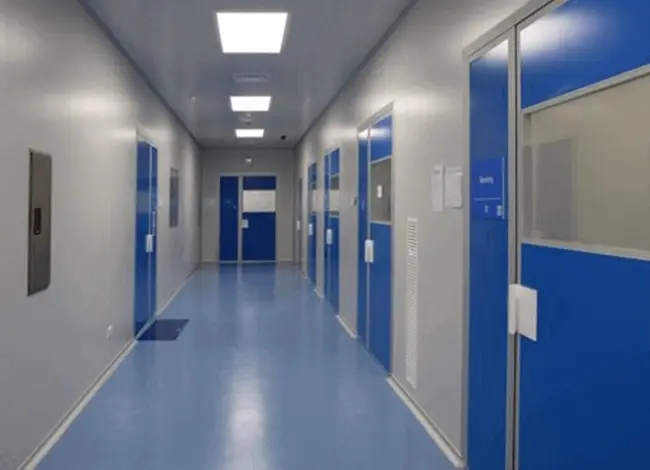
- HEPA Filters: HEPA filters can remove at least 99.97 percent of the particles smaller than 0.3 microns, and ULPA filters can trap the particles smaller than 0.12 microns. They are located in strategic positions, usually at the ceiling, to form sweeping, laminar or unidirectional moving air that compels the contaminants downwards and not upwards of the strategic work areas without compromising the cleanroom standards.
- Pressurisation: Cleanrooms are maintained at a positive air pressure relative to adjacent, less clean areas. This means the air pressure inside the cleanroom is higher, causing air to flow out of the room when a door is opened or a leak exists. This prevents unfiltered, contaminated air from seeping in.
- Extreme Air Changes Per Hour (ACH): The typical office could be having 2-10 air changes per hour. Hundreds can be found in a cleanroom. An example of this is a cleanroom of ISO Class 5 which could need 250-700 ACH. This volume of air is a mass of highly filtered air which dilutes and removes the contaminants that are produced within the room, quickly.
- Precise Temperature and Humidity Control: Even minor fluctuations in temperature and humidity can ruin sensitive processes, cause electrostatic discharge, or promote microbial growth. Cleanroom HVAC systems provide exceptionally stable and precise control over these parameters, often within a tolerance of ±1°F and ±5% relative humidity.
- Dedicated Outside Air Systems (DOAS): The systems maintain the adequate supply of fresh outside air that is forced into the main cleanroom HVAC unit in a properly treated manner. This keeps the pressurisation and introduces fresh air to occupants as well as removes internally produced gaseous contaminants.
WHY CLEAN ROOM HVAC IS CRUCIAL FOR PHARMACEUTICALS, ELECTRONICS, AND HEALTHCARE
The cleanroom HVAC system is not just an accessory; it is the fundamental infrastructure that makes the cleanroom function. Its essentiality can be broken down into four critical areas:
- Product and Process Protection: In other industries such as semiconductor production a single microscopic particle landing on a silicon wafer can result in a fatal defect, that is, it makes a microchip useless to the tune of thousands of dollars. Any microbes that are aired in pharmaceutical compounding or biotechnology can contaminate an entire lot of sterile injectables or cell cultures with dire health consequences to patients and huge loss of money by the company. The first and largest line of defence against these types of contaminants is the HVAC system.
- Personnel Comfort and Protection: Although the main aim is to secure the process, the system should also have the ability to support those humans who are inside. It ensures safe and comfortable atmosphere by delivering fresh air that is breathable, carbon dioxide that goes out, and temperature regulation. The HVAC system is also used in bio-hazard or pharmaceutical needs where strong chemical substances are used because it serves to seal the operator inside a negative pressure zone and regulate the exhaust air to ensure that it contains high-risk chemicals.
- Regulatory Compliance: Operating in sectors like pharmaceuticals, medical devices, and aerospace is governed by stringent international standards and regulatory bodies like the U.S. Food and Drug Administration (FDA) and the European Medicines Agency (EMA). These regulations mandate specific air cleanliness classifications, pressure differentials, and monitoring protocols. A validated and properly functioning cleanroom HVAC system is a non-negotiable requirement for obtaining and maintaining regulatory approval to manufacture products.
- Operational Consistency and Repeatability: Specific regulation of the cleanroom HVAC system is the reason why experiments and production processes can be duplicated to the exact day of the week, of the year, no matter the season. This homogeneity is essential to quality control, validity of the research and the efficiency of the operations in general.
A cleanroom HVAC system is an advanced engineering marvel that is much more than climate control. It is an invaluable resource that proactively develops and protects the clear environment that keeps the technological advancement, scientific breakthroughs, and safe production of products that the current society relies on.
FACTORS TO CONSIDER WHILE CHOOSING THE VENDOR
The technology is only as good as the company that designs, installs, and supports it. For this reason, one must do exhaustive research before making a choice:
- Experience & Expertise: Select a vendor who has a history of doing business in your industry. They will only know your special needs regarding regulation and performance when they have experience in the specific line of work. In addition, request case studies and references of similar size and complexity of projects. A business that is already established will be the most proud to demonstrate it.
- Design Capabilities: Ensure they have qualified engineers in-house who can perform detailed load calculations, airflow modelling, and create compliant design drawings. Avoid vendors who simply sell equipment without custom design services. The vendor should work as a partner with you, your architects, and contractors from concept to completion.
- Project Management: Technical expertise may not always translate into effective project management capability. Ensure that you get a single point of contact for maintaining clear communication and accountability throughout the project. Their team should be able to provide a clear report on how work is progressing on a timely basis to ensure project viability.
- Quality of Installation: This is yet another aspect of the work that cannot be overlooked. Improper installation can ruin the best-designed system. Keeping this in mind, be sure to inquire about their installation team. Do they represent in-house or subcontract? How are they trained? Installation is essential in leak prevention and performance.
- Long-Term Support: The HVAC technology is dynamic and in constant need of care and attention; this is why it is important to select a vendor who offers more than installation and validation of the service. It must also encompass planned servicing, spare parts and software update and so on and other pertinent services that will see the system last long.
CHALLENGES AND FUTURE PROSPECTS OF CLEAN AIR SOLUTIONS
Cleanroom HVAC systems are undeniably impressive feats of engineering; however, they are plagued by significant operational and economic challenges. The primary hurdles include:
- Immense Energy Consumption: These systems are the most infamously energy consuming ones in a facility as they usually contribute to 60-70 percent of the total energy consumption. This is attributed to continuous running of strong fans that blow the air against the high static pressure of HEPA/ULPA filters as well as the intensive energy needed to achieve the accurate cooling and dehumidification.
- Operational Complexity and Stability: Having a constant stability in temperature, humidity and pressurisation is a demanding task. The slightest changes can compromise quality of products and the process of keeping pressure cascades is complicated by such daily conditions as staff circulation and door opening.
- Specialised Expertise and Compliance: These complex systems also require the designing, installation and maintenance of these systems with a heavy reliance on few well trained engineers and technicians. Such knowledge also plays an important role in dealing with the detailed validation and compliance processes required by strict regulatory standards which are not only time consuming but also costly.
Nevertheless, the future of cleanroom HVAC is bright due to the technological innovation that tends to improve efficiency, intelligence and sustainability. The operations will be revolutionised by the integration of smart technologies. Further development of Building Management Systems (BMS) is also going to employ AI and machine learning that make energy use dynamically optimised, automatically adjusting airflow, temperature and pressure depending on the occupancy and the load imposed by processes in real time. This move towards fixed setpoints will be replaced by a responsive data-driven approach, which will be a driving force of cutting the enormous energy footprint.
Mak Clean Air Systems is a leading cleanroom HVAC system supplier. A team of industry experts established the company in 2008. Since that period the business has been expanding slowly and steadily. Our organisation specialises in cleanroom heating, ventilation and air conditioning (HVAC) systems that include modular walls, doors, air handlers, and other facilities. Each individual product is manufactured with utmost care to study, produce, or a special project. We guarantee you the best quality that there could be in regards to any need that you may have.
Related Link: HOW OPERATION THEATRES MANUFACTURERS IN INDIA ARE TRANSFORMING MODERN HOSPITALS