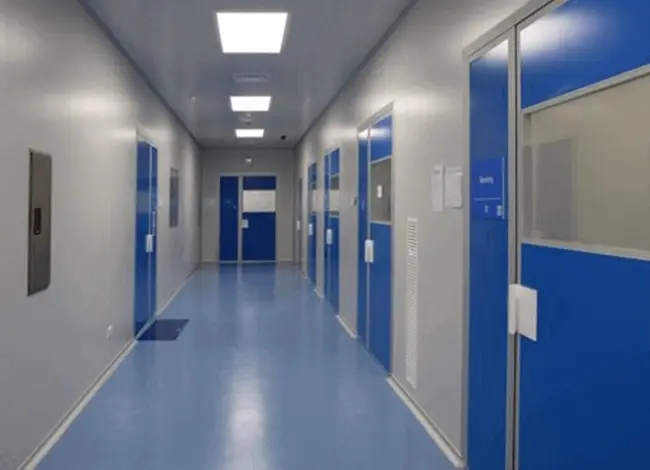
The demand for contamination-controlled environments is exploding, driven by advancements in pharmaceuticals, biotechnology, semiconductors, and advanced manufacturing. In response, traditional construction methods are being rapidly eclipsed by modular clean room panels, which represent the undeniable future of cleanroom design. This shift is fueled by four powerful advantages: unparalleled speed, supreme flexibility, superior performance, and long-term value.
- Speed of Construction and Installation: Modular cleanroom panels are pre-built in controlled factory settings off-site and delivered preassembled. It can reduce project timelines by up to half over traditional approaches, allowing business to enjoy time-to-market of vital products, and greatly lessen expensive idle time in facilities.
- Future-Proof and Scalability: This is a quality inherent to the modular design. With the dynamics of processes, regulations, and scale of production, modular cleanrooms can be restructured, scaled or moved without demolition. This flexibility not only secures the capital investment, but also enables companies to change direction within a limited timeframe in dynamic industries which is an essential asset that the traditional construction cannot provide.
- Advanced Performance and Compliance: They feature seamless, non-porous surfaces and airtight seals that are easier to maintain and far more effective at preventing particulate generation and microbial harbourage than traditional methods.
- Lifecycle Cost-Efficiency: Though the initial outlay can be more, the savings during the long-term are substantial. Less maintenance is required, less energy is used because of the better insulation and little inconvenience caused when any changes are made in the future will result in a drastically reduced total cost of ownership.
- As the need for speed and adaptability continues to grow, modular construction will become the standard, leaving traditional methods behind. Keeping this in mind, modular clean room panels are not just an alternative; they are the logical evolution of cleanroom technology.
ADVANTAGES OF CHOOSING MODULAR CLEAN ROOM PANELS FOR YOUR FACILITY
- Easy Expansion & Reconfiguration: Facilities can be easily expanded, reduced, or completely reconfigured to meet changing production needs.
- Future-Proof Investment: Protects against obsolescence. A cleanroom is an asset that can grow with the business, not a set cost that gets in the way.
- Reduce Construction Time: These products are produced in other places and are ready to be assembled immediately on the ground. This reduces the construction time without excessive construction materials.
- Lower Cost: Even though the cost of materials may be the same, savings come from cutting down on labour hours and shortening construction schedules.
- Reusability: Panels can be disassembled, relocated, and reused in a new facility, offering tremendous value over traditional walls that must be demolished.
- Non-Porous Surface: The panels consist of non- shedding materials such as steel, aluminium, and reinforced plastic which do not shed off and have low maintenance expense.
CORE COMPONENTS AND CONSTRUCTION
A typical modular cleanroom solution is a sandwich composite structure, known as a Structural Insulated Panel. Its performance is defined by its layers:
- Core Material: The inner layer provides the panel's structural integrity, insulation, and often fire resistance.
- Polyurethane (PUR): This is a material that provides good thermal insulation. It is light in weight and is fire-retardant.
- Polystyrene: Lower fire resistance than PUR; but well insulated at a lower cost than PUR.
- Mineral Wool: The top of the market in fire safety. It is totally non-combustible and offers great sound damping.
- Honeycomb Paper: A very lightweight and green choice where non-critical partitions and areas are considered and high insulation is not a priority.
- Face Sheets (Cladding): The outer layers encase the core, providing a smooth, cleanable, and durable surface.
- Galvanised Steel: The industry standard. Strong, economical and simple to wash
- Stainless Steel: Applied in very corrosive environments, like in some life sciences applications or in cases where aggressive chemicals are used to provide disinfection.
- Aluminium: Light and Non-Corrosive, but in some cases may be inferior to steel.
- Speciality Coatings: Coatings can be applied to surfaces with anti-microbial finishes, conductive or tough epoxy paints in any colour.
- Joint System: It is the most important technology that makes the system modular and airtight. Panels are constructed with structures into them that allow the panels to interlock. To create an airtight seal, a joint is closed with a gasket or sealant.
HOW TO CHOOSE THE RIGHT CLEANROOM PANEL MANUFACTURER
Selecting the right modular cleanroom panels manufacturer is as critical as choosing the panel specifications. Focus on these key areas:
- Proven Expertise and Industry Experience: Find a manufacturer that has a strong portfolio of projects finished within your industry. This experience is translated into being aware of the peculiarities of challenges and providing the appropriate solution.
- Commitment to Quality and Certification: The manufacturer should have a certified quality management system, e.g. ISO 9001. This makes the production standards consistent and documentation dependable.
- Technical Support and Design Capabilities: Evaluate their ability to provide comprehensive design support, including detailed CAD drawings and BIM models. They should not only provide parts, but also help you make your layout more efficient and compliant.
- Project Management and Logistics: Assess their process for managing orders, production schedules, and shipping. Timely, well-organised delivery is crucial to keeping your project on track.
- After-Sales Service and Warranty: A strong warranty protects your investment. More importantly, gauge their commitment to after-sales support. A reliable partner supports you for the entire lifecycle of your cleanroom.
Ultimately, choose a manufacturer that is transparent, communicative, and demonstrates a clear commitment to being a long-term partner in your success, not just a supplier.
HOW TO CHOOSE THE RIGHT MODULAR CLEAN ROOM PANEL
Selecting the right cleanroom panel is a critical decision that hinges on your specific application's requirements. Follow this structured approach to ensure optimal performance, compliance, and value.
- First, think about the level of cleanliness required, since different industries like pharmaceuticals, electronics, or food have different standards.
- Next, look at the panel material—options like steel, aluminium, or laminated surfaces are common, and you should pick one that is strong, easy to clean, and resistant to chemicals if needed.
- Insulation can also be taken into account, because thermal and sound insulated panels can increase comfort and efficiency. Durability and fire resistance should not be ignored particularly when safety is concerned.
- Lastly, think of how simple the panels are to set up, sustain and develop in future as modular systems are designed to be adaptable.
With these considerations in mind, it is possible to find panels that will guarantee a safe, effective, and sustainable clean room. You should always consult a reputable clean room panel manufacturer to confirm what you have chosen.
Mak Clean Air Systems is a leading modular clean room panel manufacturer in Hyderabad. The firm was established in 2008 by an ensemble of forward-looking entrepreneurs. Ever since that time, the company has been expanding at a slow and steady pace. Our company specialises in the production of cleanroom heating, ventilation, and air conditioning (HVAC) systems, which include modular walls, doors, air handlers, and other pieces of equipment. For the sake of research, manufacturing, or special projects, each and every item is constructed with the utmost accuracy. We guarantee the highest possible quality for each and every need.
No more second-guessing and lengthy discussions to ensure your decision is correct. Partner with the top modular cleanroom panels manufacturer in India – contact Mak Clean Air Systems!
Related Link: HOW OPERATION THEATRES MANUFACTURERS IN INDIA ARE TRANSFORMING MODERN HOSPITALS